Why Doctors Need Managed IT Services in 2026

Managed IT services are defined as outsourced, continuously monitored technology support that covers security, compliance, and infrastructure for healthcare providers. For doctors, dentists, and allied health administrators, this is not optional infrastructure. It is the operational backbone that keeps electronic health records (EHRs) online, patient data protected, and HIPAA audits survivable. Ransomware attacks on hospitals and clinics reached 445 confirmed incidents in 2025 alone. Understanding why doctors need managed IT services starts with recognizing that healthcare is now one of the most targeted industries in cybersecurity, and reactive IT support is no longer adequate.
What cybersecurity threats make managed IT services necessary for doctors?
Healthcare is the most ransomware-targeted sector in the United States. In 2025, over 10 million records were confirmed breached across hospitals and clinics, with average ransom demands reaching $615,000 per incident. That figure does not include recovery costs, legal exposure, or the reputational damage that follows a public breach notification.
The threat profile for medical practices is specific. Attackers target healthcare because patient records contain Social Security numbers, insurance data, and prescription histories. This makes them worth far more on the dark web than standard financial records. A single compromised workstation in a dental office or outpatient clinic can give an attacker lateral access to your entire network within hours.
Continuous IT monitoring and comprehensive security practices directly reduce ransomware risks and operational outages. This includes patching routines, endpoint controls, multi-factor authentication (MFA), email filtering, and documented incident response plans. A managed IT provider deploys these controls systematically, not as one-off fixes.
Pro Tip: Ask any managed IT provider you evaluate whether they use endpoint detection and response (EDR) tools like SentinelOne. Generic antivirus is not sufficient for healthcare environments facing modern ransomware variants.
Proactive threat detection through a security information and event management (SIEM) platform, such as Microsoft Sentinel, allows your IT team to identify anomalous behavior before it becomes a breach. Without this layer, most practices only discover an attack after the damage is done.
How do managed IT services support HIPAA compliance?
The Office for Civil Rights (OCR) reports that many healthcare breaches are directly tied to HIPAA Security Rule noncompliance in three recurring areas: incomplete risk analysis, deficient audit controls, and weak authentication practices. These are not exotic technical failures. They are documentation and process gaps that managed IT programs are specifically designed to close.
HIPAA compliance is not a one-time certification. It is an ongoing operational discipline. Managed IT services support this through:
- Risk analysis documentation: Regular, structured assessments that identify vulnerabilities in your systems and workflows, creating the paper trail OCR expects.
- Access controls and MFA: Enforcing role-based access so only authorized staff reach protected health information (PHI), with MFA as a mandatory second layer.
- Encryption: Ensuring data is encrypted at rest and in transit across all devices, including mobile phones and laptops used outside the clinic.
- Audit trail monitoring: Logging and reviewing who accessed what data and when, which is a direct HIPAA Security Rule requirement under 45 CFR §164.312.
- Vendor management: Reviewing and maintaining Business Associate Agreements (BAAs) with every third-party vendor that touches PHI.
Effective healthcare cybersecurity depends on repeatable, documented processes rather than one-off fixes. This is precisely what a managed service provider (MSP) model delivers. Your practice gets a consistent compliance posture, not a scramble before each audit.
Pro Tip: Before signing with any MSP, confirm they will provide a written HIPAA risk analysis as part of onboarding. If they cannot produce this document, they are not equipped for healthcare environments. Businessitsupport includes this as a standard component of its healthcare IT compliance engagements.
Why is IT reliability crucial for clinical workflow and patient care?
About 90% of U.S. office-based clinicians now use at least one form of EHR, and patient portals, clinical decision support tools, and care coordination platforms all depend on reliable IT uptime. When your network goes down, clinical documentation stops. Prescription orders stall. Lab results become inaccessible. The downstream effect on patient safety is direct and measurable.

Unmanaged IT significantly increases the risks of clinical errors and operational disruption in EHR-dependent environments. A provider who cannot access a patient’s medication history during an appointment is forced to rely on memory or delay care. Neither outcome is acceptable.
Here is how managed IT services protect clinical uptime in practice:
- 24/7 infrastructure monitoring: Servers, network switches, and endpoints are monitored around the clock. Issues are flagged and addressed before they cause downtime, not after a staff member calls to report a problem.
- Rapid issue resolution: Managed IT providers maintain defined response time agreements. A critical system failure in a medical practice gets a response in minutes, not hours.
- Tested backup and disaster recovery: Reactive break/fix IT leads to longer downtime and unreliable recovery. Managed IT providers run scheduled backup tests to confirm your data can actually be restored when needed.
- Patch management: Operating system and application patches are applied on a scheduled basis, closing security vulnerabilities without disrupting clinical hours.
- Help desk support for clinical staff: Physicians and nurses are not IT professionals. A dedicated support line means clinical staff get fast answers without pulling a colleague away from patient care.
The practical result is a practice where IT problems are resolved before they reach the exam room.
What operational benefits do doctors gain from managed IT services?
Beyond security and compliance, managed IT services change the operational character of a practice. The shift from reactive to proactive IT management is the most significant change most practices experience.
| Reactive IT (Break/Fix) | Managed IT (Proactive) |
|---|---|
| Problems addressed after failure | Issues identified and resolved before impact |
| Unpredictable costs per incident | Predictable monthly fee structure |
| No documentation of system changes | Full change control and audit trail |
| Vendor coordination handled internally | Bundled support for Microsoft 365, clinical systems, and hardware |
| Backup reliability unknown until needed | Scheduled backup testing with verified recovery |
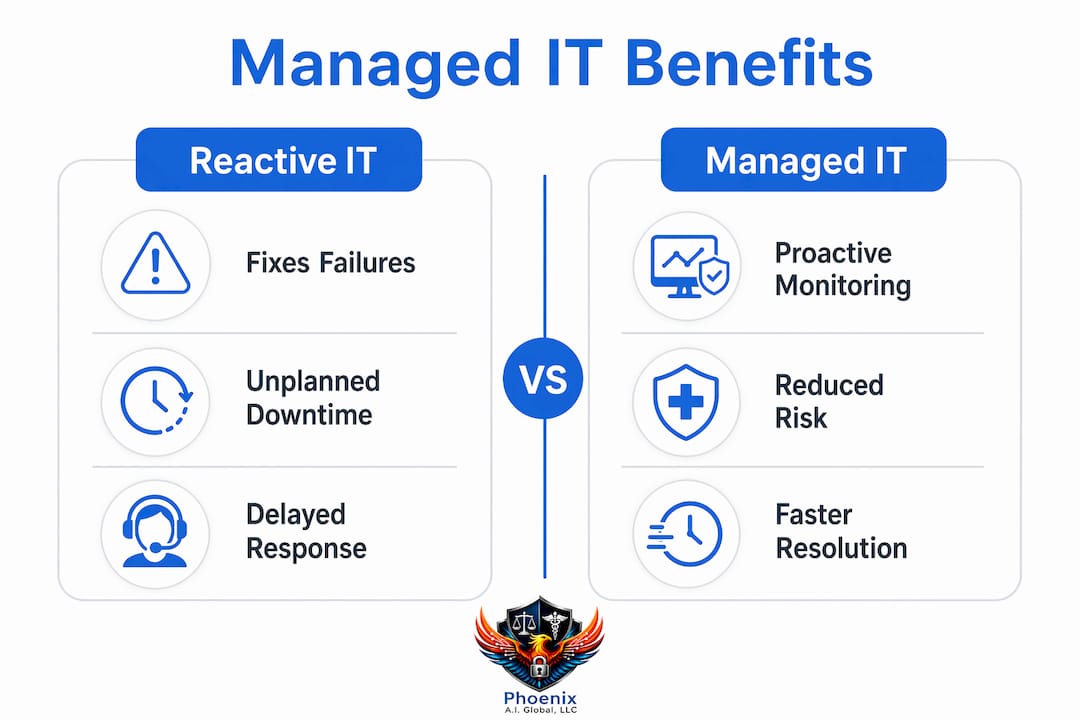
Configuration drift across multi-site healthcare operations is a key risk that managed IT programs address through standardization and documentation. If your practice has two or three locations, each running slightly different software versions or firewall configurations, you have hidden vulnerabilities that will not surface until an incident occurs.
Managed IT services also support complex licensing and vendor coordination, reducing the internal burden on practice administrators. Instead of tracking separate contracts for Microsoft 365, your EHR vendor, your VoIP system, and your backup solution, a managed provider consolidates oversight and escalates vendor issues on your behalf.
Pro Tip: When evaluating managed IT providers for a multi-location practice, ask specifically how they handle configuration management across sites. A provider without a documented standardization process will create more problems than they solve as your practice grows.
How to choose and integrate managed IT services in a healthcare setting
Selecting the right managed IT provider for a medical or dental practice requires more than comparing price sheets. The integration process matters as much as the service catalog.
Start with a structured assessment before any contract is signed:
- Asset inventory: Document every device, server, and application in your environment. This includes clinical workstations, mobile devices, networked printers, and any cloud platforms used for patient communication.
- Security baseline review: A healthcare IT risk assessment identifies your current exposure across network security, access controls, and data handling practices.
- EHR and clinical system compatibility: Confirm the provider has experience with your specific EHR platform, whether that is Epic, Athenahealth, Dentrix, or another system. Misconfigured integrations create compliance gaps.
- Phased onboarding: A responsible MSP onboards in phases, starting with monitoring and documentation before making infrastructure changes. This minimizes disruption to clinical operations.
- Cloud and hybrid planning: If your practice is moving workloads to Microsoft Azure or adopting cloud-based clinical tools, your managed IT provider should have documented experience with healthcare cloud compliance requirements.
- Coordination with in-house IT: Many practices have a part-time IT person or office manager handling basic support. A good MSP defines clear boundaries and escalation paths rather than creating conflict over responsibilities.
The goal is a support model where your clinical staff never think about IT because it simply works.
Key takeaways
Managed IT services are the most direct way for healthcare providers to address cybersecurity risk, HIPAA compliance, and clinical uptime simultaneously within a single, predictable support model.
| Point | Details |
|---|---|
| Ransomware risk is acute | Healthcare faced 445 attacks in 2025 with average ransom demands of $615,000 per incident. |
| HIPAA compliance requires ongoing processes | OCR enforcement targets risk analysis gaps, weak authentication, and missing audit controls. |
| EHR reliability depends on managed IT | With 90% of clinicians using EHRs, unmanaged IT directly threatens clinical documentation and patient safety. |
| Proactive IT outperforms break/fix | Tested backups, patch management, and 24/7 monitoring prevent downtime rather than responding to it. |
| Multi-site practices need standardization | Configuration drift across locations creates hidden vulnerabilities that only surface during incidents or audits. |
What we have learned from healthcare IT in the field
Working directly with medical and dental practices, the pattern we see most often is this: a practice runs on reactive IT for years without a major incident, then experiences one ransomware event or OCR audit and realizes how exposed they were the entire time.
The practices that recover fastest are not necessarily the ones with the most sophisticated technology. They are the ones with documented processes. They know exactly which systems hold PHI, who has access, and what the recovery procedure looks like. That documentation does not exist by accident. It exists because someone built and maintained it systematically.
The hybrid IT model, where a managed provider handles security and compliance while a part-time internal resource handles day-to-day requests, works well for practices between 10 and 50 staff. The key is a clear escalation matrix so nothing falls through the gaps. We have seen practices where the internal person and the MSP each assumed the other was handling patch management. Neither was. That is a preventable failure.
One more observation: the practices most resistant to managed IT adoption are often the ones most overdue for it. The physician who says “we have never had a problem” is describing luck, not security. The threat environment in 2026 does not reward complacency.
— Businessitsupport
Protect your practice with purpose-built managed IT support
Businessitsupport delivers managed IT services built specifically for medical, dental, and allied health practices. Every engagement starts with a Zero Trust security foundation, HIPAA-aligned risk analysis, and 24/7 monitoring using SentinelOne and Microsoft Sentinel. You get predictable support, documented compliance processes, and a team that understands the difference between a patient portal outage and a routine help desk ticket.
Whether you operate a single-location family practice or a multi-site specialty group, Businessitsupport provides cybersecurity and compliance services tailored to your regulatory obligations and clinical workflows. Schedule a no-obligation assessment to see exactly where your practice stands today.
FAQ
What are managed IT services in healthcare?
Managed IT services in healthcare are outsourced technology support programs that provide continuous monitoring, security, compliance management, and help desk support for medical and dental practices. They replace reactive break/fix IT with a proactive, documented support model.
How do managed IT services help with HIPAA compliance?
Managed IT providers maintain the technical safeguards required under the HIPAA Security Rule, including risk analysis documentation, access controls, MFA, encryption, and audit trail monitoring. OCR enforcement data confirms that most breaches trace back to gaps in exactly these areas.
How often do healthcare organizations face ransomware attacks?
Healthcare organizations faced 445 ransomware attacks in 2025, with average ransom demands of $615,000. Continuous monitoring and endpoint protection from a managed IT provider are the primary defenses against these attacks.
Can a small medical practice afford managed IT services?
Managed IT services are priced on a per-device or per-user monthly model, making them accessible for practices of all sizes. The cost of a managed IT program is typically far lower than the cost of a single ransomware recovery or OCR penalty.
What should I look for in a healthcare managed IT provider?
Look for documented HIPAA compliance experience, specific knowledge of your EHR platform, 24/7 monitoring capabilities, and a structured onboarding process that includes a security risk assessment. Providers without healthcare-specific credentials are not equipped for the regulatory demands of medical environments.
Recommended
- Managed IT Services for Dentistry: What You Need to Know | Business IT Support
- HIPAA & ABA-Compliant IT Services Phoenix | Managed IT, Cybersecurity, EMR, Legal Software & Marketing | Business IT Support
- IT Insights & News | Business IT Support Phoenix
- Managed IT Services Phoenix, AZ | Business IT Support — Security-First MSP