Managed IT Services for Dentistry: What You Need to Know

Managed IT services in dentistry are defined as outsourced, proactive technology management programs that cover a dental practice’s entire IT ecosystem, from cybersecurity and HIPAA compliance to help desk support and disaster recovery. Unlike traditional break/fix IT support, where you call someone after something breaks, managed IT operates continuously in the background. The industry term for this model is Managed Services Provider, or MSP, and when tailored for dental offices, it includes specialized tools like SentinelOne for endpoint protection, Microsoft Sentinel for threat detection, and AI-driven analytics platforms such as those offered by Planet DDS. For dentists and practice managers, understanding what managed IT services dentistry actually delivers is the difference between reactive chaos and a practice that runs with confidence.
What is managed IT services in dentistry?
Managed IT for dental practices is a subscription-based model where a specialized provider takes full responsibility for your technology infrastructure. This is not a helpline you call when your X-ray software crashes. It is a continuous, structured program built around the specific compliance, security, and operational demands of a dental office.
The services included under this model go well beyond basic tech support:
- Continuous monitoring and patch management: Your systems are watched around the clock. Software vulnerabilities are patched before attackers can exploit them, and hardware health is tracked proactively.
- Disaster recovery and backup for dental imaging: Dental practices store large imaging files alongside patient records. Effective dental MSPs validate backups daily and perform restoration tests to confirm that data can actually be recovered within your target recovery time.
- User onboarding and offboarding: When a front-desk employee leaves, their access to patient scheduling systems, billing software, and email must be revoked immediately. Managed IT providers build this into a documented process, reducing the risk of insider threats.
- HIPAA compliance management: This includes secure application recommendations, access controls, audit logging, and documentation that satisfies HIPAA’s technical safeguard requirements.
- Help desk and onsite support: 24/7 help desk support resolves minor issues remotely, while SLAs define fast response times for critical failures that require an onsite visit.
Pro Tip: Ask any prospective managed IT provider to show you a sample backup restoration test report. If they cannot produce one, their disaster recovery promise is theoretical, not operational.
What separates a dental-focused MSP from a generic one is fluency in the tools your practice actually uses: Dentrix, Eaglesoft, Carestream, and similar platforms. A provider who has never configured HIPAA-compliant access controls for dental practice management software will cost you time and compliance exposure.

How do managed IT services protect security and compliance?
HIPAA violations due to data breaches can cost dental practices millions in fines, and the enforcement environment has grown more aggressive. A managed IT provider builds your security posture from the ground up, rather than bolting protections onto an already-vulnerable system.
Here is how a well-structured managed IT engagement addresses compliance and security in sequence:
- Zero Trust architecture from day one. Every user, device, and application is treated as untrusted until verified. This eliminates the assumption that anything inside your network is safe, which is the assumption most breaches exploit.
- Managed Detection and Response (MDR). Tools like SentinelOne provide AI-powered endpoint detection that identifies and contains threats in real time, rather than waiting for a scheduled scan to catch malware.
- Backup validation and disaster recovery testing. Practices rarely test restorations, but a managed IT provider runs these tests on a defined schedule. Without tested backups, a ransomware attack does not just cost you a fine. It can shut your practice down for days.
- User permission management. Access to patient data is granted on a least-privilege basis and revoked immediately upon offboarding. This single control eliminates a significant category of HIPAA risk.
- Audit-ready documentation. Managed IT providers maintain logs, access records, and security reports that satisfy HIPAA’s documentation requirements and support you during an audit or breach investigation.
“Dental managed IT should be viewed not just as support but as a strategic partner enhancing communication, compliance, and operational analytics.” — TMC Insight
The HIPAA-compliant IT framework that Businessitsupport builds for dental clients integrates these controls from the first day of engagement, not as an afterthought. That distinction matters when a breach investigation begins.
What operational benefits do dental practices gain beyond security?
Security is the floor, not the ceiling. The operational benefits of managed IT for dental practices extend into scheduling, patient communication, staffing efficiency, and financial performance.
Reduced downtime and predictable costs
Proactive maintenance and 24/7 help desk support reduce unplanned downtime that disrupts patient flow and billing. When your practice management software goes offline mid-day, every minute of downtime translates directly to lost revenue and patient frustration. Managed IT providers operate under SLAs that define maximum response and resolution times, so you know exactly what to expect. Single flat-rate per-user pricing replaces unpredictable repair bills with a fixed monthly cost, making IT a line item you can plan around.
Unified communications and patient experience
Unified communications platforms unify voice traffic across your office, enabling consistent call routing, reducing missed appointments, and providing real-time dashboards that show call wait times and staff responsiveness. For a busy multi-operatory practice, this is the difference between a patient who books and one who hangs up and calls a competitor.
Pro Tip: Real-time analytics dashboards from unified communications tools can reveal call spike patterns tied to specific days or times. Use that data to adjust front-desk staffing before the bottleneck costs you appointments.
AI-driven analytics and financial impact
AI-driven analytics identify patient interactions that need follow-up, flag training opportunities for staff, and surface operational bottlenecks that manual review would miss. The financial stakes are significant. According to the Planet DDS 2026 Dental Industry Deep Dive Report, closing operational billing gaps aided by optimized IT infrastructure can add approximately $890,000 in annual EBITDA for a dental service organization with $10 million gross production. That figure reflects 6.1% consistent growth and 28% more revenue per chair for optimized practices. The implication is direct: IT infrastructure is not a cost center. It is a revenue variable.
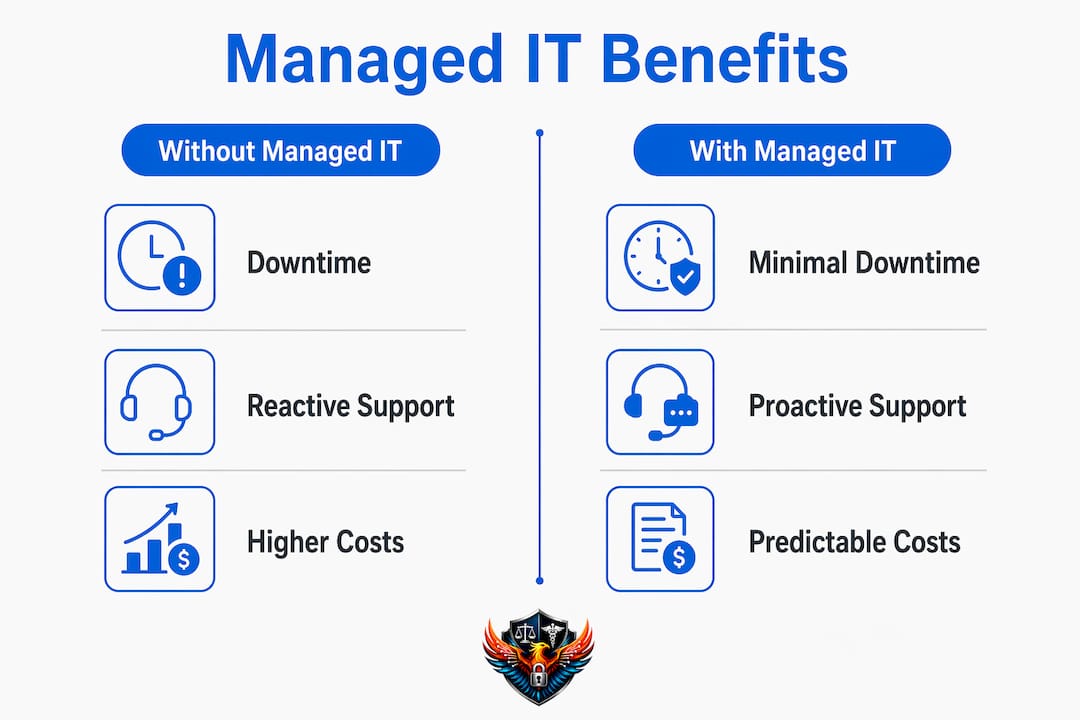
| Operational Area | Without Managed IT | With Managed IT |
|---|---|---|
| Downtime response | Reactive, hours to days | Proactive, SLA-defined minutes |
| IT budgeting | Unpredictable repair costs | Fixed per-user monthly rate |
| Patient call handling | Inconsistent, missed calls | Unified routing with analytics |
| HIPAA documentation | Manual, incomplete | Automated, audit-ready |
| Backup reliability | Assumed but untested | Daily validated and tested |
What engagement models exist for different practice sizes?
Managed IT providers offer two primary engagement models for dental practices: fully managed and co-managed services. Choosing the right model depends on your practice size, internal capabilities, and growth trajectory.
Fully managed services are designed for small to mid-size practices and single-location clinics that have no internal IT staff. The MSP handles everything: infrastructure monitoring, security, compliance, help desk, vendor management, and strategic planning. You get a complete IT department without hiring one. This model works well for practices where the dentist or office manager currently handles IT issues personally, which is a situation that creates both security gaps and significant time drain.
Co-managed services are built for larger group practices or dental service organizations that already have an internal IT person or small team. In this model, the MSP provides specialized capabilities that the internal team lacks, such as MDR, HIPAA compliance auditing, or advanced security operations using Microsoft Sentinel. The internal team handles day-to-day requests while the MSP covers the security and compliance layer. This collaboration model avoids the cost of hiring specialized security staff while giving the internal team expert backup.
Both models operate under formal Service Level Agreements. SLAs for dental managed IT clearly define response and resolution times based on issue priority, guaranteeing rapid support during critical downtimes and reducing revenue loss. A well-written SLA distinguishes between a printer jam and a server outage, assigning appropriate urgency and accountability to each.
The two engagement models offer flexibility based on dental group size and internal IT capability, which means there is no single correct answer. The right choice is the one that fills your actual gaps without paying for redundant coverage.
Key takeaways
Managed IT services for dentistry deliver measurable security, compliance, and operational value when built on Zero Trust principles and tailored to dental-specific workflows.
| Point | Details |
|---|---|
| Definition matters | Managed IT is proactive, continuous management, not reactive break/fix support. |
| HIPAA is non-negotiable | Violations carry multi-million dollar fines; managed IT enforces controls that prevent them. |
| Backups must be tested | Daily validation and restoration testing are the standard, not optional extras. |
| Operational ROI is real | Optimized IT infrastructure can add up to $890,000 in annual EBITDA for a $10M DSO. |
| Model choice is size-dependent | Fully managed suits small clinics; co-managed suits larger groups with internal IT staff. |
Why most dental practices are still underprotected
After working with dental and healthcare clients for years, the pattern Businessitsupport sees most often is not ignorance. It is misplaced confidence. Practice managers assume their current IT vendor handles HIPAA compliance because the vendor set up their server. That assumption is rarely correct. Most general IT providers do not audit user permissions, test backup restorations, or maintain the documentation HIPAA requires. They fix what breaks. That is not the same as managing risk.
The practices that get into serious trouble are not the ones that ignored IT entirely. They are the ones that thought they had it covered. A front-desk employee leaves, their credentials stay active for weeks, and a breach investigation later reveals that access was never revoked. That is a HIPAA violation that a managed IT provider with a proper offboarding process would have prevented on day one.
The technology trends worth watching right now are AI-assisted threat detection, Zero Trust network access replacing legacy VPNs, and AI analytics platforms that connect patient communication data to staffing decisions. Dental practices that build their IT infrastructure around these capabilities now will have a measurable operational advantage over those that wait. The data protection standards expected of dental providers are only going to increase. The right time to build a proactive IT strategy is before the audit, not after.
— Businessitsupport
How Businessitsupport supports dental practices
Businessitsupport delivers managed IT services built specifically for healthcare and dental practices, with Zero Trust security, HIPAA compliance management, and 24/7 help desk support at the core. Every engagement includes SentinelOne endpoint protection, Microsoft Sentinel threat monitoring, and documented compliance controls that hold up under audit. Whether your practice needs fully managed IT or co-managed support to strengthen an existing internal team, Businessitsupport offers flexible models sized to your practice. Explore the full range of cybersecurity and compliance services or contact the team directly to discuss what your practice actually needs.
FAQ
What does managed IT services mean for a dental practice?
Managed IT services for a dental practice means a specialized provider takes ongoing responsibility for your technology infrastructure, covering security, HIPAA compliance, help desk support, and disaster recovery under a fixed monthly agreement.
How does managed IT help with HIPAA compliance?
Managed IT providers enforce HIPAA technical safeguards through access controls, audit logging, user offboarding processes, and audit-ready documentation, reducing the risk of violations that carry multi-million dollar penalties.
What is the difference between fully managed and co-managed IT?
Fully managed IT replaces an internal IT department entirely, while co-managed IT supplements an existing internal team with specialized security and compliance capabilities the team does not have in-house.
How often should dental practice backups be tested?
Effective managed IT providers validate backups daily and perform full restoration tests on a defined schedule to confirm that patient data and imaging files can actually be recovered within the practice’s recovery time target.
Can managed IT services reduce costs for a dental practice?
Yes. Flat-rate per-user pricing replaces unpredictable repair bills, and proactive monitoring reduces costly downtime. Optimized IT infrastructure has been linked to up to $890,000 in additional annual EBITDA for dental service organizations with $10 million in gross production.
Recommended
- HIPAA & ABA-Compliant IT Services Phoenix | Managed IT, Cybersecurity, EMR, Legal Software & Marketing | Business IT Support
- Managed IT Services Phoenix, AZ | Business IT Support — Security-First MSP
- Managed IT Services Scottsdale, AZ | Business IT Support — Security-First MSP
- Managed IT Services Phoenix | Security-First MSP for Healthcare & Law Firms | Business IT Support